To Be Substainable Collect More Tax

The “S” word again.

The city’s proposed general fund budget shows a growing deficit of $2.4 million for the 2020-2021 fiscal year, $3.5 million for 2021-2022 and $5 million for 2022-2023.

“This is not sustainable and we need to get to a structurally balanced budget, where our income or revenues can adequately pay for our spending or expenditures,” Uslar wrote to the council.

Hotel tax is important because it provides 28% of the city’s total revenue, more than property tax and sales tax combined.

To Be Substainable Collect More Tax

Not Getting That Promised Pot Tax Revenue

High taxes and overregulation are a big buzzkill.

A bill was introduced Monday in the California legislature that would give legal cannabis businesses a tax break to help them thrive and better compete with the underground market.

In a release announcing the proposed bill, state officials said cannabis taxes can eventually generate $8 to $20 billion in annual revenue for California. The current taxes imposed on the state’s cannabis industry were part of Proposition 64, the adult-use legalization measure passed by California voters in November 2016.

California started selling legal marijuana last year, but some observers have blamed the aggressive state tax rates and overregulation for continuing underground pot sales.

Not Getting That Promised Pot Tax Revenue
[CNBC]

Jenny McAdams Cheats On Her Property Tax

Oopsie! It was a mistake. Sure. And she owns a house in Seaside dontcha know.

A City Council candidate did some scrambling this week when she was told that a property tax deduction she took would indicate she had recently made Seaside her primary residence.

Jenny McAdams, who lives in a rented home in Pacific Grove, said she unknowingly took the $7,000 primary residence deduction on her property tax on the Seaside home she owns in which she says she has long-term renters.

According to Monterey County Assessment Clerk Darlene Bagwell, the $7,000 homeowner’s exemption is entitled to those who own and occupy the home as their primary residence. With it, $7,000 is taken off the accessed value of the property, which amounts to saving $70 a year.

Jenny McAdams Cheats On Her Property Tax

$2,700,000 For Pot Enforcement

Enforce the use of MJ or enforce the tax collection or enforce the wha, what I forget. Let’s see if the cannabis taxes can cover those millions.

Marijuana

Supervisor Jon Phillips noted the cannabis program had initially asked for more than $10 million, then cut the request to $7.4 million before settling at $2.7 million during a tough 2018-19 budget year. It was known that the assigned funding might need to be adjusted based on demonstrated program need. Phillips said it’s still possible the program might need even more funding in the future.

At the same time, Supervisors Jane Parker and Mary Adams said they were concerned about devoting more money to the cannabis program after the community had made it clear during county-sponsored forums earlier in the year that its priorities lay elsewhere, including early childhood education and health initiatives rather than public safety.

$2,700,000 For Pot Enforcement

Newest TAMC Silliness – Put Buses On Railroad Right Of Way

And who really thought that Measure X was going to improve roads for cars? Better spent on substainable things like slow empty buses and more unused bicycle lanes.

Would it not be easier to use those metal ribbons and come up with some sort wheeled vehicle that could ride people from one end to the other faster and safer than MST buses?

For Monterey County, the study concluded that a “bi-directional” busway along the branch line between Fremont Boulevard and Reservation Road would be the “most cost-effective alternative,” noting that it is supported by TAMC’s Measure X funding (about $15 million designated for bus rapid transit, along with potential grant funding). The project cost is currently estimated at about $33.4 million, according to a TAMC staff report.

Newest TMC Silliness – Put Buses On Railroad Right Of Way

Politicizing The Butterfly

Butterfly Molesting

Ahhh politics. Here’s a the work of one that looks good

Assemblymember Mark Stone — whose district includes Pacific Grove’s Monarch Sanctuary — is pushing a bill, AB 2421, to protect the iconic black and orange insects. “As monarch butterfly populations decline, ecosystems across our state are at risk of collapse,” said Stone, who introduced the bill in February. “This measure provides grants and support to preserve and restore monarch and other pollinator habitats.

Then we see what it really is. Looks like another tax and spend project.

The bill would establish the Monarch and Pollinator Rescue Program, which would be overseen by the California Wildlife Conservation Board. The program would offer grants to farmers, ranchers, nonprofits and public agencies to pay for habitat restoration projects throughout the state.

Politicizing The Butterfly

Uh, About All That Tax Revenue From Legal Weed

Looks like it will be less than promised.

In a split vote Tuesday, the Monterey County Board of Supervisors cut marijuana businesses’ tax rates, in some cases by two thirds, said Luis Alejo, the board’s chairman.

Greenhouse growers, who had been staring at a $15-per-square-foot tax, will instead pay $5 per square foot while indoor cultivators will pay $8 a square foot, he said.

Uh, About All That Tax Revenue From Legal Weed

P.G. Pays $25,000 To Oakland Survey Company Only To Find The Obvious

Tax the tourists. Oh, and 41 percent come up negative on short term cyber rentals.

The survey also showed that 41 percent of the 375 likely voters surveyed on the phone and online believe that the city has done a “poor” job of managing the city’s vacation rentals, while 28 percent gave the same grade for the way the city manages its pension obligations. Similarly, 22 percent said P.G. is doing poorly managing its finances.

P.G. Pays $25,000 To Oakland Survey Company Only To Find The Obvious

Monterey Getting $8,000,000 For A Short Section Of Recreation Trail Improvements

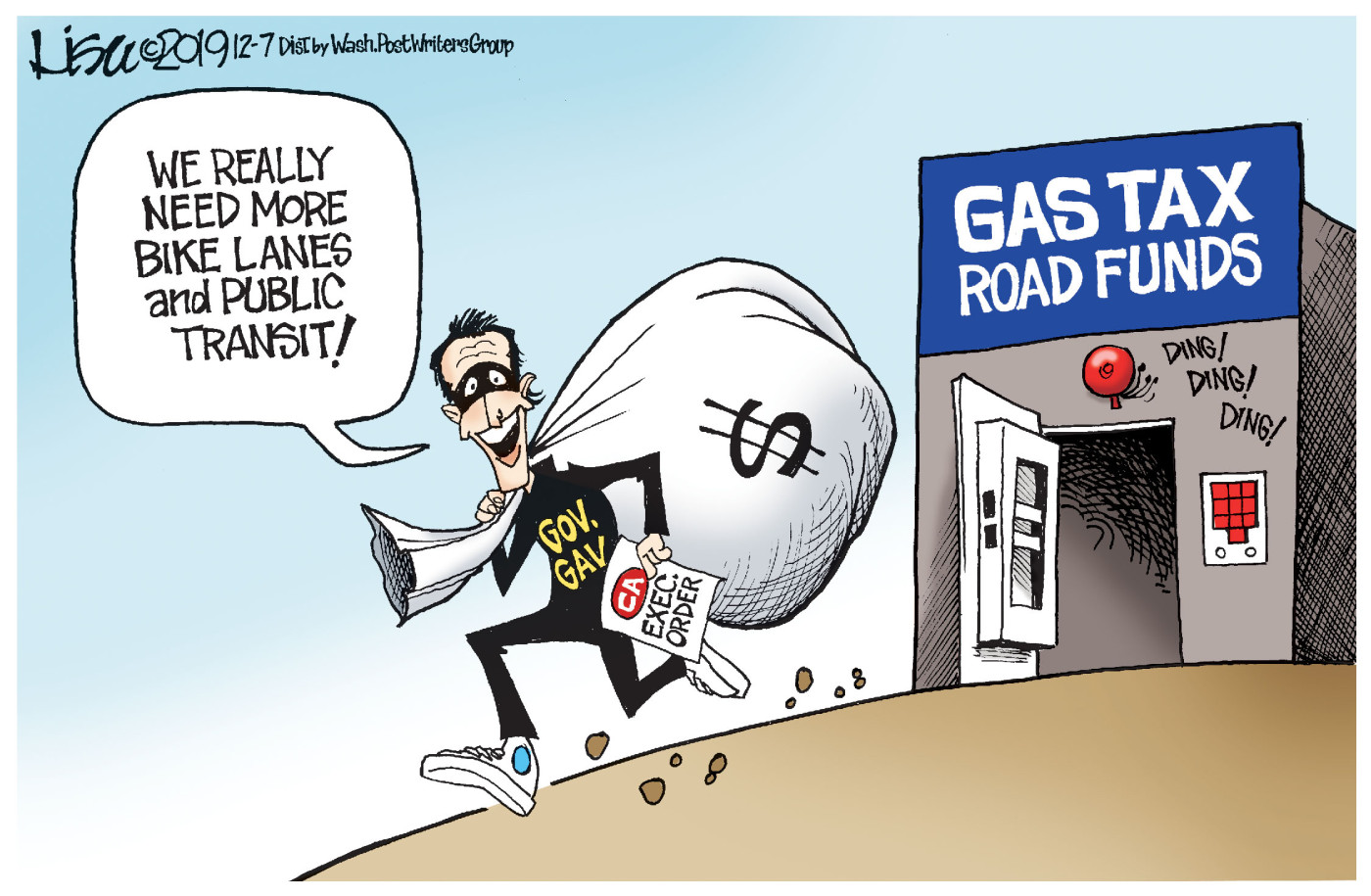
Eight Million Dollars for “to go from Fisherman’s Wharf to the Coast Guard station”. The money is coming from a grant (taxes) called the Road Repair and Accountability Act of 2017 that was sold to the tax payers as an investment to fix our roads, freeways and bridges in communities across California. As usual, Governor Moonbeam lies about where our tax dollars are spent.

At least put some lights up and maybe a few 911 phones to cut down on the rapes, robberies and assaults that happens on that dangerous trail.
Rec Trail Graff

“Solutions for congested corridors are usually for Los Angeles or San Francisco so one of the things that we try to do with this grant is highlight the importance of offering an environmentally friendly and alternate form of transportation,” said Andrea Renny. She said that by creating a smoother running trail, drivers could be swayed to become bikers, therefore the improved Rec Trail could also serve to alleviate congestion on the road. And while some have advocated for the need to separate the bicyclists and pedestrians in that stretch of the trail, Renny said that the Parks and Recreation Master Plan calls for widening the trail first before other alternatives can be considered.

Monterey Getting $8,000,000 For A Short Section Of Recreation Trail Improvements

Solar Not Substainable

Never put any trust in operations where government handouts are the first source of funding.

Sungevity is laying off workers, auctioning off some assets, and agreeing to hand over control investors in exchange for $20 million in financing to keep the company’s operations going.

Sungevity was one of seven residential solar power companies, which Congress announced in September it would formally investigate for wrongfully receiving billions in tax credits from the government. The federal government likely handed out roughly $25 billion in cash grants and tax credits to these companies.

Another solar company called Beamreach went bust in January after it received $3 million in Department of Energy funding in 2008. The major solar company SunEdison also recently declared bankruptcy. Roughly five major solar companies closed up shop in 2015, which follows the historic tendency that solar power companies tend to go bankrupt as soon as the subsidies are cut off.

Solar Not Substainable